
Deposit
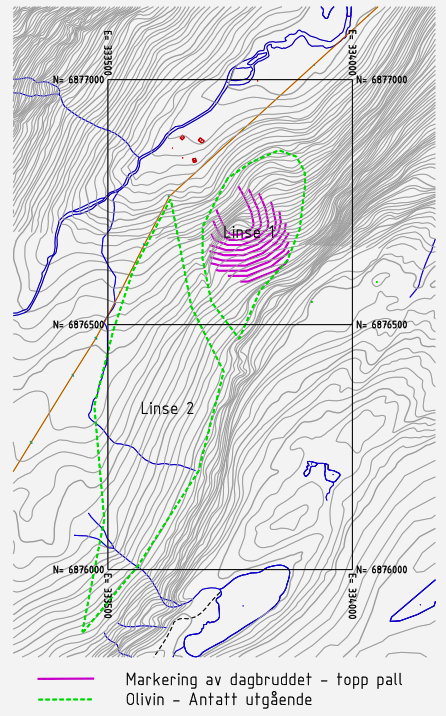

Lenses 1 and 2
The olivine deposit consists of at least two separate lenses, lens 1 and lens 2, as shown in the figure. Between lens 1 and lens 2 there is a gneiss zone with a thickness of 35–50 m.
The contour lines on the map indicate a distinct ridge, referred to as Raudhamaren.
The deposit is interpreted to have a bowl-shaped body that lies against, and partly beneath, the overlying gneiss in the area from Raudhamaren and northwards over a length of 300–400 m. The strike is northeast, and the dip at the top is 45–50 degrees towards the southeast.
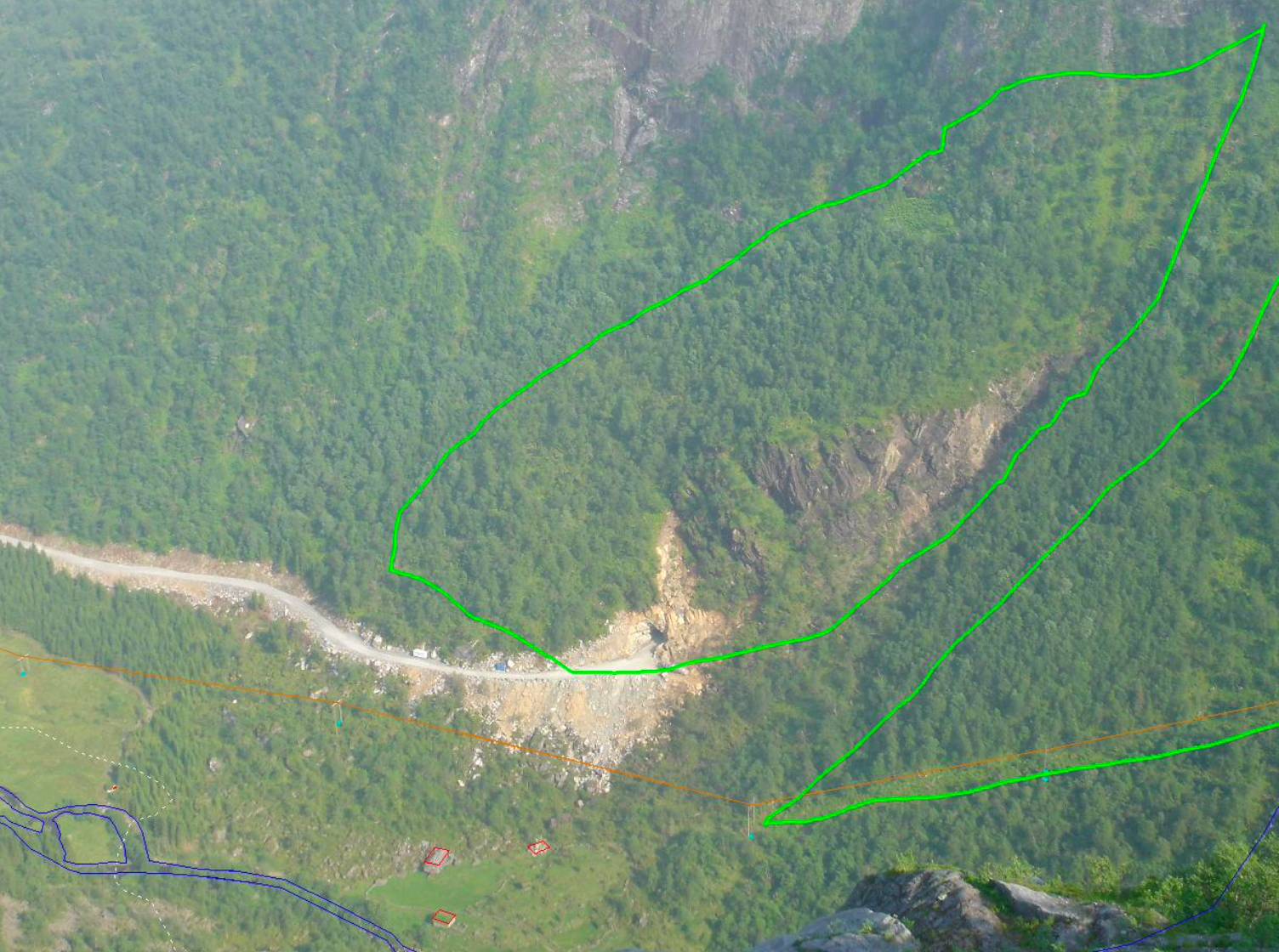

Linse 1 og 2
As the level of knowledge about the deposit is not uniform throughout, it is necessary to distinguish between reserves, which are olivine occurrences that with a high degree of certainty can be found and extracted, and resources, which are observations of olivine that require further investigation before they can be classified as reserves.
In parts of lens 1, the open-pit reserves are estimated at 2.5 million tonnes.
At the current stage, lens 2 must be regarded as a resource.
Overview lens 1
The black lines mark zoning boundaries and bench heights.
Reserves
Lens 1 is well mapped.
The lines indicate strike and dip.
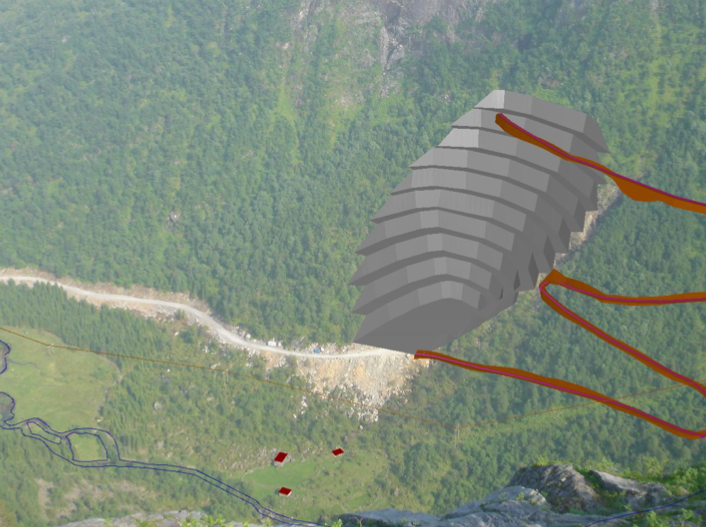
Haul road and open pit
A dedicated haul road has been established from the open pit down to the stockpile at Treneset.
Here we see a simulated model of the open pit.